
1848 vs. 1898
Wars Mexican & Spanish 1776-1917 Book Excerpt 5

Hello all! Still inching forward on the book I’m writing. Here’s the next excerpt of “American Empire: The First Hundred Years” which finishes off the first chapter. You can find the earlier excerpts here:
This excerpt starts off with the last paragraph from the last one…
William Appleman Williams exhaustively documented the way that US farmers advocated for the expansion of US markets through world empire at the beginning of the 20th century. But how many Americans work on farms today? About 1.3%. Yale Historian Michael Brenes has documented how the “Cold War Coalition” of corporate and big labor interests constantly intervened in domestic politics to raise tensions and overcommit the United States abroad in the name of boosting defense expenditures. But Professor Brenes also shows how this money has shifted over the past 80 years. The massive weapons assembly lines of yore have faded away, and the Pentagon’s billions now go to dozens of engineers and executives rather than tens of thousands of manufacturing workers.
1848 vs. 1898
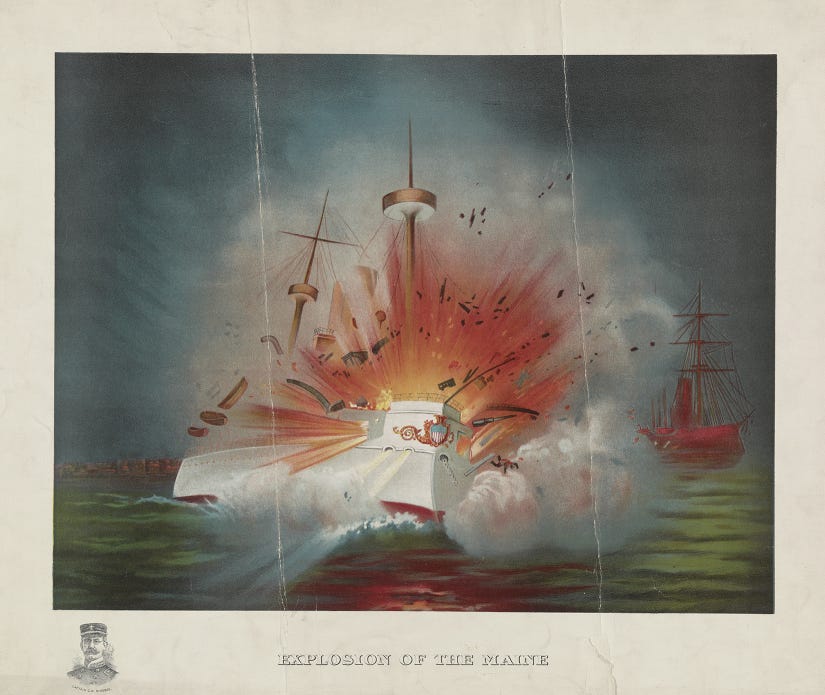
The accumulation of imperial benefits, away from the American people, and to a few small elites, accelerated over the course of the 20th century, but the trajectory was already clear in the 19th. We can see it by quickly comparing the two most significant years of US empire building that are outside of the scope of this book: 1848, which saw the end of the devastatingly successful Mexican-American War, and 1898, which saw the launch of the previously mentioned Spanish-American war, a war of much wider scope and much more historically ambiguous results. Both wars had elite and popular elements arguing for and against them, but in the aggregate, the war for Mexico was a more bottom-up, democratically motivated sort of war, while the Spanish-American war was a more top-down, elite driven one.
It may seem odd to present the Mexican war as a “bottom-up” war when you consider the pivotal role of James K. Polk. If the Mexican-American War wasn’t so contemptible an example of outright theft, Polk would be remembered as one of our greatest presidents. He came to the presidency in 1845 with the straightforward, ludicrously ambitious goals of: annexing Texas; settling the Oregon question; and taking today’s US West from Mexico. In just four years he accomplished all three. The very top of US society, the 11th president, wanted to go to war, but he was not alone in this. The ease with which Polk accomplished his ambitious goals is an indicator of how much of the country was with him. I do believe it is fair to call this war a democratically motivated one, and not just because Polk was a Democrat. Migrants from the US had created Polk’s Texas opportunity by moving there in previous decades. There were real material benefits to be had for a much broader swathe of the US public than any US empire building offers today, and masses of white male voters knew that.
Polk was also a Jacksonian Democrat, much more representative of the wishes of the broader public than the Whig party of the time. Some of that Whig party, a precursor but by no means a direct analogue of the Republican party of any era, was firmly opposed to the Mexican-American War. He had very little influence at the time, but an Illinois congressman by the name of Abraham Lincoln was one such opponent. Polk, setting a trend, used his presidential power to create the Mexican-American war, intentionally fashioning an incident that could be claimed to be a Mexican attack. Everybody saw through it at the time. But not enough people cared. There was land to be had. There was no way that a US congress would have voted for war in a vacuum. A populist president had to engineer the circumstances. The genesis was shameful, but it’s impossible to argue that the US public did not receive tangible benefits from the war. The prize parts of the territory Polk’s policies added to the US, Texas and California, now amount to about a quarter of total US GDP.
With the Spanish-American war 50 years later the benefits to the US masses are much harder to see. There were certainly US businesses that benefitted tremendously from the war that started in 1898. While almost any white man could set up a California farm in the mid-19th century, only a small elite had the wherewithal to set up a Cuban sugar refinery in the early 20th. Trade preferences for Cuban sugar in the first half of the 1900s probably hurt more US producers than they helped.
The Spanish-American war gave us: William McKinley, the first US president who may have killed a million people[1]; a failed half century of attempted imperial rule in the Philippines that lasted just long enough to drag us into a war with Japan; a viciously poisonous relationship with Cuba; and Guamanian and Puerto Rican protectorates that remain uncomfortable open questions down to today.
The Spanish-American war was not the product of democratically racist desires for land, it was an elite driven project. The “Yellow Journalism” that agitated for war came out of wealthy, coastal imperialist factions that were desperate to insert the United States into the world power games that the Europeans and the Japanese were playing at the time. The atrocities the Spanish were committing against Cuban revolutionaries were used to build up a war-fever, but the war was prosecuted as much to keep the Cuban revolutionaries from achieving full success, and damaging US business interests, as it was to kick the Spanish out of South America.
US Empire’s Shitty Little Adolescence
From the US it’s easy to look at Europe’s loathsome carving up of Africa around the turn of the 19th and 20th centuries with a sense of superiority. The Belgian King Leopold has the worst reputation, but the European conquest of Africa was near universally a foul sink of genocide, brutality, and vicious racism. Even worse it was a largely pointless prestige game, that only benefitted a few famous pirates like King Leopold and Cecil Rhodes. Individual imperialists benefitted enormously, but the broader European publics emphatically did not. The Scramble for Africa was a drain on the resources of every country that participated and fostered the “prestige above all else” environment that led directly to Europe’s civilizational near-suicide in World War I. The US can be proud that our only contribution to the nightmare in Africa was Liberia, where we set up an upper caste of blacks liberated from American slavery. We can look with some superiority at the horrors committed by Belgium, Germany, France, Britain and others on that continent, because we weren’t involved. Sadly, the only reason we weren’t involved was because we were too busy playing similarly brutal games in our own hemisphere.
Before Presidents McKinley (1897-1901) and Teddy Roosevelt (1901-1909), most US politicians at least mouthed anti-imperial platitudes. Woodrow Wilson claimed to return to anti-imperial form. But something quite gross happened leading up to the Spanish-American war in 1898. It would be nice to believe that we transitioned seamlessly from continental rapine to the calmer, often more benign world domination of today. Unfortunately, McKinley, and especially Roosevelt, pushed to turn us into just another little wannabe empire running around the British titan’s ankles, murdering brown people. The fact that Teddy Roosevelt ended up immortalized on Mt. Rushmore along with Lincoln, Washington and Jefferson is a quirk of timing. He was just the most popular recent president in the 1920s when the structure was planned.
Teddy Roosevelt actively wanted us to be a European style imperial competitor and he did everything he could to insert us in those games. He did this in the McKinley administration, and as President after Mckinley’s assassination in 1901. The US record in the Philippines was atrocious. Much like Cuba, in 1898 we decided to destroy the Spanish presence there to get out ahead of a local rebellion that was succeeding more quickly than we liked. The US press had made too much of the cause of Cuban independence, so we couldn’t annex the island outright. There were no such limitations in the Philippines.
The US public felt no political commitment to any kind of Filipino autonomy. We decided to take the islands for ourselves, and fought a horrific exterminatory war from 1899-1902 to do so. Concentration camps, village clearances, and attempts to wipe out the populations of whole islands were all part of this largely forgotten story. Estimates of the civilians killed by this war range from 250,000 to a full million. Rudyard Kipling’s infamous poem “White Man’s Burden”, calling on imperialists to wisely guide their “new caught sullen peoples, half devil and half child” was written to encourage the United States in this wasted, fundamentally evil effort. There was no public outcry in the US. William Howard Taft, the Governor-General of the Philippines during the height of the oppression was rewarded with a position as the Secretary of War, and then became Roosevelt’s successor as president (r. 1909-1913).
The US continued to pursue brutal, European style conquest from 1898 through the early 1930s. One of the highlights was Teddy Roosevelt’s carving Panama out of Colombia to build the Canal in 1903. By the 1920s, the US had direct control over most of the Caribbean, with outright military occupation of Nicaragua (1912-1933), Haiti (1915-1934), the Dominican Republic (1916-1924), and Puerto Rico (1898-present).
The US’s copy-cat imperialism was, in one respect, even worse than what the Europeans were doing to Africa. Unlike the majority of their fellow victims across the Atlantic, most of these Central American countries had popularly elected governments of one flavor or another. All these publics hated US occupation and voted for representatives that wouldn’t put up with it. So the United States repeatedly dissolved the legislatures and installed dictators who would do our bidding. Democracy was often in the way, so we discarded our principles and crushed it. Over and over again.
General Smedley Butler, one of the most decorated US Marines in history, played a leading role in many of these conquests. In one of the most spectacular retirements in US history, he spent the 1930s condemning what he had done, describing himself as a “gangster for capitalism” and penning an epic screed, “War is a Racket” pointing out how little his fighting had done for anybody other than Wall Street.
The Rest of The World Is An Island
Something fundamental had changed in 1898. The US was no longer taking land to be turned over to the masses. Instead US elites were seeking colonial possessions to enrich themselves, and to play petty great power games. This shift in the nature of US conquest was formalized in a series of infamous Supreme Court decisions known as the “Insular Cases”. The territory that the United States eventually incorporated as states had always benefitted from the rights laid out in the US Constitution. The indigenous tribes of the US south learned how little those rights could be worth long before the Trail of Tears in the 1830s, but in theory at least, they had those rights. The 1901 Insular Cases held that none of the territories taken in the Spanish-American war could benefit from the rights enshrined in the US Constitution. This remains the law of the land to this day.
Each of the territories initially covered by the Insular Cases has arrived at some sort of stable status quo. Puerto Rico is constantly renegotiating its status. The Philippines are independent. But I believe the Insular Cases have a broader significance. They were the point at which the switch flipped from a US empire that stole land for the many, to a US empire that governs the world for the benefit of a few. In some respects the whole planet outside of the 50 states is Puerto Rico now. The US gives and withdraws benefits, like trade deals and military protection, but nothing is guaranteed. The pre 1898 empire provided a more level playing field for US citizens and provided some rights to those who lived in the conquered territories. Now the frontier is everywhere, and only a tiny few at the top receive any benefit at all.
We Are A Continent
The old form of democratically demanded US empire is dead. But it left us with the foundation of the US empire of today. Everything else about US power is built upon it, and unlike the rest of the components of American empire described in this book, it’s almost impossible to imagine it being stripped away. The United States is a continent.
Thanks to the pioneers, we have no natural enemies. Our Canadian and Mexican neighbors pose no military threat, and they are eagerly handing over more and more of their sovereignty to us in the form of NAFTA and its successor agreements. Our military and diplomatic engagement with the rest of the world is entirely voluntary. If the entire US military disappeared tomorrow, we would be just as safe as we are today, arguably safer.
Short of nuclear apocalypse, or the explosion of the Yellowstone megavolcano or something similar, the United States will be a great power as long as the current system of nation-states endures. If we lose dollar dominance, all our overseas military bases, and all our allies, we’ll still be a continent, and likely to remain at the center of world politics. Every other country in the world is playing a much higher stakes game than the United States is.
On some level, the American empire of today is a fraud. Public resources for foreign policy, our tax dollars, are used to produce immense private fortunes, while offering very little to the US taxpayer, let alone the world at large. Empire serves the interests of the US public to the extent that we’ve avoided a world war for the past 80 years, but that’s about it, and, as this book will show, US foreign policy elites are by far the greatest threat to that 80 years peace. If the US public was getting as much out of today’s world empire as it got from expansion in the 1800s, there would be no hope for the world. But I believe that the rewards of empire today are so unevenly distributed, that if we can break the monopolies that make US foreign policy as stupid as it is, there should be plenty of resources left over to maintain peace, allow the US public at large to benefit, and allow the rest of the world to benefit as well. I hope to make that case with the balance of this book.
[1] A million dead is among the larger estimates for the amount of Filipinos killed during the US conquest of the islands. A more consensus figure is a mere 250,000 murdered out of a population of 7,000,000. “Just” 4% of the population murdered by McKinley instead of 16%.
Nice.