
Is Russia Evil?
Let's talk Chechnya, shall we?

In this week’s podcast Ruairi took a look at recent reports from the Russia Ukraine war. Has the tide truly turned? Is Ukraine finally winning?
Well, no. Ukraine’s prospects have likely brightened, but it’s more of a limited step up from a truly desperate place than a likelihood they will meet any of their ambitious war aims. Ruairi and I went over the evidence, and talked over the recent history. We arrived at a familiar impasse on the all important question of “How did we get here?”. Do Russia’s actions prove that NATO was right to expand? Or do they prove that NATO expansion was a terrible mistake? For more on that topic, please read on. Or just listen to our conversation here:
Why Is Russia Bad?
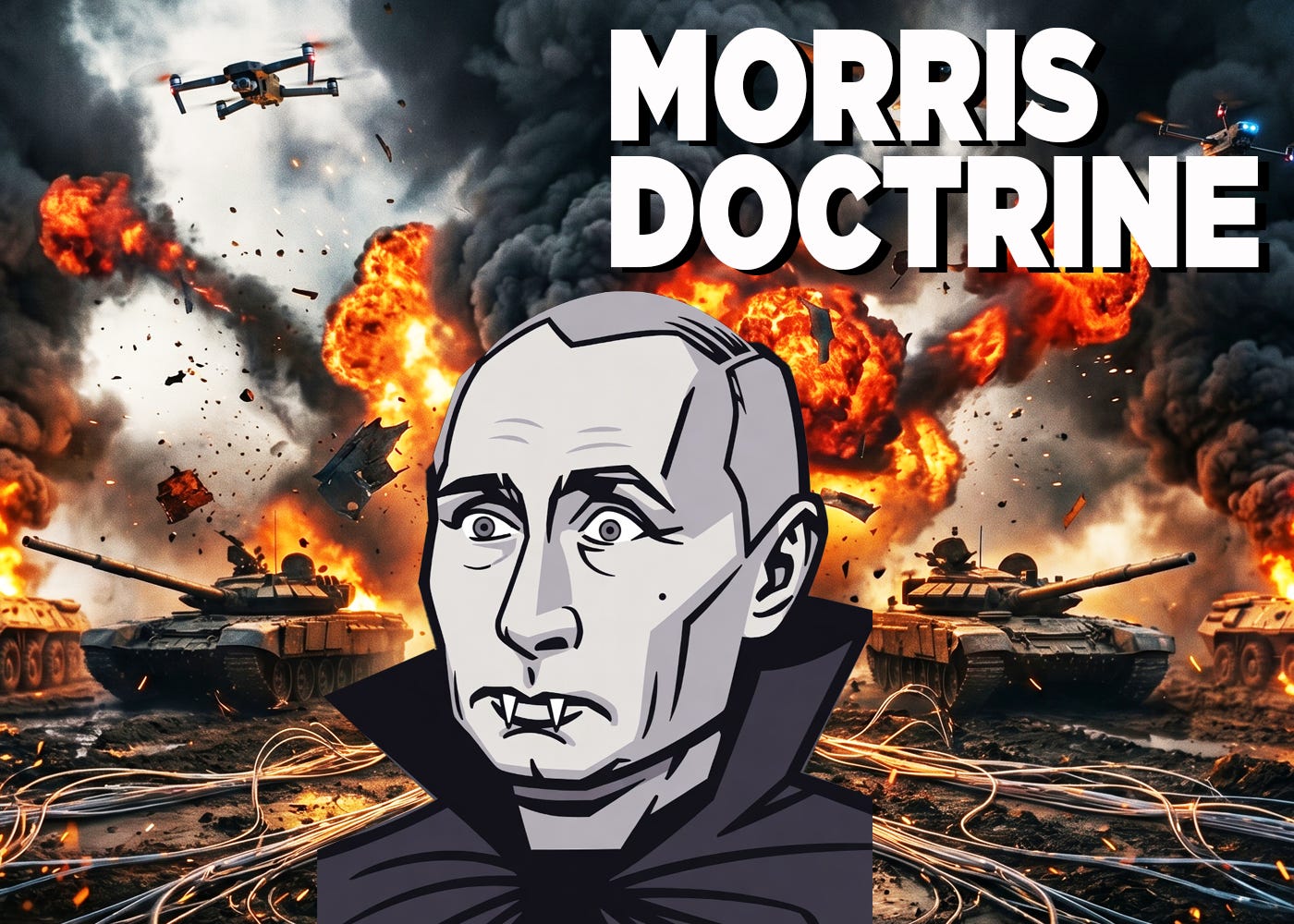
I’ve long been convinced that US policy created Vladimir Putin. Or at least it created this version of Vladimir Putin. People are willing to accept ( to a ridiculous degree ) Russian agency in US elections, but find it hard to believe that US military action against Russian allies and on Russia’s borders might influence the policies and actions of Russia’s government.
I can’t prove any of this, of course. My impression comes from similar patterns of history, and carefully watching developments for a couple decades. Critics of my “It’s NATO’s Fault!” view are correct to say there’s no way of proving it, though.
But there’s also no way to prove the “Russia is just evil” thesis. We certainly Have an aggressive Russia. Russia became aggressive in the context of this world, where the US attempted to obliterate its sphere of influence, and extended a military organization dedicated to Russia’s destruction up to Russia’s borders. My preferred path, to engage peacefully with Russia after the Cold War, was never tried. It’s not the world we live in. The idea that Russia is a naturally aggressive country has just as little evidence to back it up as my conviction that it’s all reaction.
Two to Tango
One of the most frustrating US media tendencies is to selectively report bad actions. We’ve seen this to a ridiculous extent with the current conflict in Iran. As people attempt to synthesize on-going events, they begin to omit anything that the US and Israel did to encourage or start this war, and only focus on the aggressive moves Iran made. This is a clearly ridiculous way to look at the current war, but I wouldn’t be surprised if a couple years from now the Washington, DC conventional wisdom will be that Iran started the 2026 war instead of Trump.
I am old enough to remember the miraculous end of the Cold War. Sure, the Russians were running out of money and had a stupid system, but there was no guarantee that the Soviet Union would have peacefully dissolved without ending the human species. It’s a nearly divine miracle that Mikhail Gorbachev came along and chose to end things peacefully. This is an irreducible fact of our existence, that I have a very hard time reconciling with the “We had to expand NATO to save Europe from evil Russia!” thesis that so many people live by.
Gorbachev and some of his successors seemed to legitimately believe that the end of the Cold War meant the end of armed camps, and the beginning of a “Common European Home”. Russia let its Warsaw Pact, and even its Soviet Union dissolve peacefully, with an expectation that the West might act reciprocally. Instead we expanded our Warsaw Pact equivalent, NATO, relentlessly.
Most are now aware of how Russian aggression against Georgia and Ukraine extends directly from George W. Bush’s threat to expand NATO to those countries. Thee chronology on that stuff is pretty clear, and outlined in this week’s podcast episode.
Chechnya
Ruairi helpfully pointed out something I rarely consider, which is that many consider Russia’s 1990s record in Chechnya to be support for the “Evil Russia” thesis. I admittedly take the idea of sovereignty more seriously than most. Chechnya has always struck me as a distinct issue from Georgia or Ukraine. It’s a part of Russia, so it should stay a part of Russia. I’m a pretty anti-secession person generally, having seen what it has done to Sudan & South Sudan.
I didn’t feel that way at the time, of course. I remember being quite passionate about Chechen independence in the late 1990s. This was a very prevalent view in the United States back then. I don’t recall it being a very examined position at the time. We just hated Russia by default. If the Cold War was over, and peace had broken out, why were not too engaged US college drunks like myself all on fire to further dismantle Russia? We certainly were. I think I wrote a piece calling for a Lincoln Brigade of Americans to go help liberate Chechnya.
I’ll confess I haven’t thought about the Chechen wars all that much since then. On the podcast I suggested that the chronology of those two conflicts needed to include what the US was up to in Europe at that time. I reconstructed that chronology for this post and I think it has a lot of explanatory power.
1st Chechen War (1994-1996): The backdrop here is obviously the wholesale collapse of the Soviet Union, and a lot of Russia’s state capacity. It was a brutal, ugly war, that Russia was losing at a time that Russia seemed to be losing everything else. Boris Yeltsin, Russia’s leader at the time, was also a lot more susceptible to moral pressure from the West than Putin would eventually be. Yeltsin pulled out and signed a series of agreements with the Chechen government that did not settle the final status of the country, but left it with de facto autonomy.
NATO Expands to The Communist Bloc (1997): Over the strenuous objections of Boris Yeltsin, Hungary, Poland and the Czech Republic are invited to join NATO, completing the process in 1999. They had all been members of the Warsaw Pact organization put together by the Soviet Union to defend itself from NATO. Now they were in NATO. Russia obviously didn’t like this.
NATO Bombs Serbia (1999): Tsarist Russia killed itself to defend Serbia in World War I. Slav unity wasn’t as important to Russia in 1999 as it was in 1914, but Serbia was still seen as a Russian ally in a region the US was turning against Moscow. Unlike NATO’s 1995 bombing of Serbian-aligned forces in Bosnia, the US effort to “protect” Kosovo wasn’t approved by the United Nations. It also wasn’t particularly successful. The initial bombing caused a dramatic stepping up of Serbian war crimes. It was only through a NATO occupation of Kosovo that persists to this day, that a safer status quo was established. Russia was angry enough about this that they actually sent troops to Kosovo’s capital to confront NATO, a largely forgotten example of near nuclear catastrophe.
2nd Chechen War (1999-2000): There are two data points about the 2nd Chechen War that I assume most readers are familiar with. Neither reflect very well on Russia. The war started before Putin took the reins fully on the last day of 1999, but the Chechen war became a place to prove his strongman mettle. His brutal willingness to see the war through was consciously used for his domestic political purposes.
The second data point is that a series of apartment bombings in killed over 300 people in Russian cities in 1999. It’s become a near article of faith in US circles that these were some kind of false flag operation concocted by Putin. I’m not sure how true that is, but I suppose it’s possible. I’d just always assumed, from reading US media, that the Chechen war was all about Putin’s domestic priorities, and the main justification for it was, at the least, pretty flimsy.
I was surprised to learn this morning that Putin had not actually started the hostilities in the 2nd Chechen war. It wasn’t even the Russian government. No, that was the Chechen rebels who invaded the neighboring Russian province of Dagestan.
So let’s consider the Chechen conflict from the Russian perspective. Let’s do it without omitting all the relevant 1990s context the way we usually do in US media.
In the early 1990s Russia loses vast swathes of its empire, including some regions that had been part of the country since the 1500s. All of their sway over Central Europe that they had lost 20 million lives in World War II to gain evaporated as well. Desperate for western approval, and money, Yeltsin agrees to concede a level of autonomy to Chechnya in 1996. What was his reward?
In 1997 the US incorporates Central Europe into its military alliance. In 1998, the Russian economy collapses into bankruptcy, proving Yeltsin’s strategy to be fruitless. In 1999, NATO becomes the first great power alliance to bomb a major (ish) European city since 1945. That city, Belgrade, is the capital of the only European country, Serbia, that ever has anything nice to say about Russia. In 1999 the Chechens Russia granted autonomy to… invade Russia. With drunken US college kids (like me!) cheering them on.
So how evil was it, really, for Russia to try to roll back the tide in Chechnya? The horrors of Grozny weren’t a good thing. But was Russia the only actor that matters here? Were they supposed to just roll over and let more Russian territory spin away?
When you look at the larger context, it’s a lot harder to call Russia evil. We’ve been painting them into a corner since the 1990s. It’s a weak country with an array of bad choices, that occasionally makes some horrific ones.
You can listen to today’s conversation on Spotify, or you can watch it on YouTube at the link below…
"Instead we expanded our Warsaw Pact equivalent, NATO, relentlessly....
....All of their sway over Central Europe that they had lost 20 million lives in World War II to gain evaporated as well."
This phrasing implies that the countries that *joined* NATO have no agency whatsoever, in fact they don't have any *right* to agency, because Russia won WW2.
The idea that NATO was a threat to Russia, that a few hundred Canadian or Danish troops in Lithuania were going to roll into a nuclear armed Russia and take Moscow is risible.
Putin's kleptocracy is not a place you might want to raise a family. The democratization of Eastern Bloc countries is bringing liberal democracy(let's call it 'rule of law' democracy) closer to Moscow, and that's Putin's real fear. NATO (a defensive military alliance) is not and never has been a threat to Russia. Countries like Finland, Sweden, Poland and Estonia have no territorial expansionist dreams. These former non-NATO countries just want to participate in a peaceful economic union, but their security is threatened by the psychopath next door. Sign me up on the 'it's not NATO expansion's fault' side, I'd argue that position all day long. Putin would be far better off if he brought his battered army home and tried to reintegrate Russia(the largest and perhaps the most resource-rich country on the planet) back into the global community. If NATO expansion was Putin's real problem, he's done everything possible to make it worse. The sad thing is that Ukraine has become NATO, and I can't help but admire their tenacity. Trump could have ended the war in a day; all he had to do was arrest Putin the moment he stepped on American soil, and what was left of the kleptocracy would have turned on itself.