
This Isn't 1939
Or 1914

Today’s podcast is part 2 of our conversation with Sean McFadden of Deep Noetics. We range pretty widely, talking about the origins of World Wars I & II, the Cold War, and the current state of geopolitics and a whole lot more. Eventually the conversation came around to how bad things are currently and, uncharacteristically for this channel, how bad they are not.
Trump’s chaos machine has put the world in an uncomfortable hard to predict place. So far, so standard, you can read that in the New York Times. Sean and I go deeper. We talk about the structure of previous eras that led to violence, and talk about how much more sustainable and peace-oriented the world of today is compared to earlier periods of transition. We look into the early decades of the 20th century that commentators are obsessed with comparing to the modern day, and lay out why those comparisons don’t make much sense.
That’s right, believe it or not, we arrived at a fairly optimistic place! You can listen to today’s podcast to follow the argument one way, or you can read on for some more detail on the stark differences between today and the time periods leading up to the World Wars.
World War Isn’t Inevitable
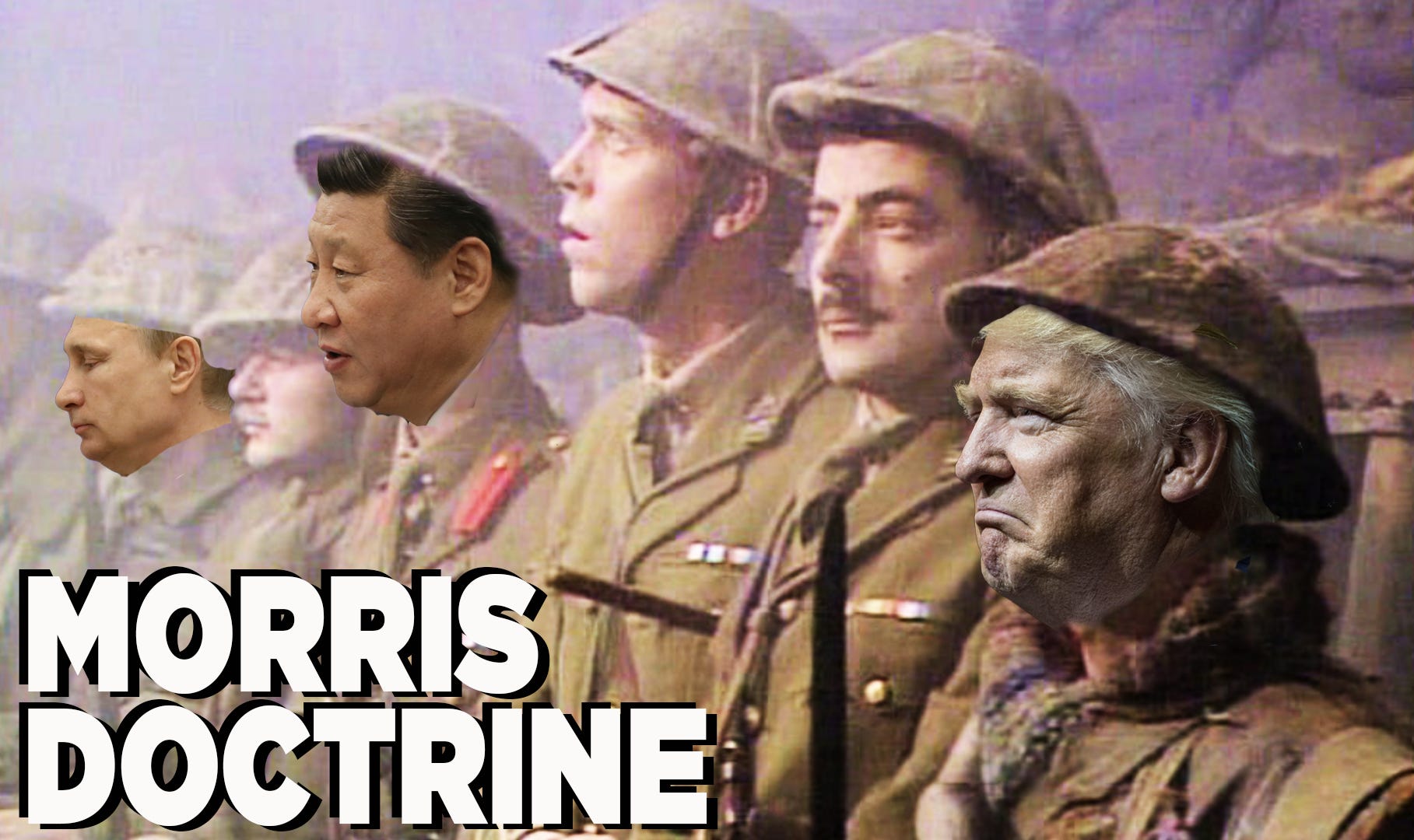
It’s always tempting to make comparisons. Our brains love it. Comparisons are especially interesting in history and geopolitics, where there are a wealth of ways to contrast historical eras, and one country to the next. Certain eras loom larger than others, and the 1930s, followed some distance behind by the 1910s, probably loom largest. The reasons why are simple. The defining events of the 20th century, only now sliding out of living memories, are the two world wars, the first starting in 1914 and the second starting in 1939 (for Europe).
In the conversation above Adam Tooze, one of my favorite historians, emphasizes how unprecedented our historical times are. Tooze finds this very unsettling, and warns New York Times podcaster Ezra Klein that none of our historical models accurately capture what’s happening that now. I’d highly recommend the entire conversation, but I’m not sure I find the lack of parallels as disturbing as Tooze does. History is a terrible place! We should be happy that our current conditions don’t match up with past ones.
Not the 1930s
The idea that today is uncomfortably close to the 1930s has been a military industrial complex trope for years. If we’re in the 1930s, then we need to prepare for war, and we should be spending even more money on weapons! Long before Trump brought masked thugs to our streets, this comparison was being trotted out all the time. The 1930s featured the rise of strong man dictators, and so did the 2010s!
This sort of thinking is good enough for silly payola think tanks like the Atlantic Council, but it doesn’t hold up to historical scrutiny. Putin and Xi are very unpleasant, but there is simply no comparison to the Nazis and the Japanese empire. Putin finally did get around to trying to conquer a single country, after we egged him on to do it for a couple decades, but that’s nothing like the continent-spanning marches across continents that Hitler and Hirohito were engaging in. Putin and Xi want to take back territories that mostly speak Russian and Chinese, the 1930s dictators really were trying to take over the world.
If we’re being honest, this century has really only featured one country that wants to use military force to reshape the world, and that’s the country that already runs the planet, the United States. The US is infinitely more powerful than Imperial Japan or Nazi Germany too, so our ambitions are potentially a lot scarier. But the world is vastly different, and much more resilient than it was in the 1930s, so even our potential for destruction has been constrained.
In our marches across Europe, the Middle East and North Africa since 2001 we’ve destroyed at least a dozen countries and killed millions. But that’s not the 100 million that the world wars killed in much shorter periods of time. Planet Earth as a whole is just infinitely tougher than it was in the 1930s, and even US power can only push it so far.
There’s one more vital factor missing that makes today completely different from the 1930s. We don’t have World War One. There may be no more significant factor in how the 1930s played out than the horrific conflict all Europeans had experienced just 20 years before (1914-1918). As we’ll get to in a second, the 1910s were pretty unstable, but then the war ripped the whole world open. The world was an open wound that had barely begun to scab over before the 1929 financial crash renewed all the wounds. The borders, ideologies, and psychologies of everyone from Europe’s leaders to the brawling veterans in the streets were a bloody mess, literally and figuratively.
You can’t understand the era of high fascism without understanding that Europe was filled with millions of men who were still almost young, and had vivid lived experience of violence and killing. They were willing to bring the war home in ways that are unimaginable today. And thank god for that.
Despite its popularity as a point of comparison, the 1930s were probably one of the most unique historical decades we’ve ever experienced. The combination of a population traumatized by industrial war and the collapse of an economy that had only been knit into a single world unit in the preceding decades was unique and uniquely malign. Some historians don’t even see World War I and World War II as separate things. They see them as one big conflict with a 20 year pause in between. It’s vastly less silly, and a much more serious historical project to attempt to compare the present day to the 1910s, and the run-up to World War I.
Not the 1910s
This comparison fails as well though. It can be tempting to look at a rising China challenging the hegemonic United States and compare it to the rising Germany challenging the hegemonic British in the 1900s and the 1910s. This is the basis of the Thucydides Trap nonsense that Harvard and the Atlantic have been pushing on us for over a decade now. If you’re interested in a full hour dismantling that concept, check our podcast episode from last year. As soon as I started reading deeply about the run-up to World War I, and the 19th century that the 1900s were still very much a part of, I could see the ridiculousness of this comparison. I made the video below 12 years ago…
The video above focuses on the blood-hungry aristocratic nature of European ruling classes that no longer exists. The US Congress and some European institutions remain under the sway of blood-hungry weapons companies and that’s a massive problem. But it’s nowhere near as bad as the unaccountable ruling class that openly celebrated and lusted after war that ran all European countries in 1914.
My past decade of reading has given me a larger appreciation for the structural factors that differentiate 1914 and 2025. The differences are obvious when you think about it, but almost never mentioned in US commentary. In 1914, the entire world was divided up between a few European powers. Even Japan and the Americas were pretty firmly in the British camp. All of the world’s wealth and power was focused on who would control one small peninsula sticking off the Eurasian continent.
While their wealth was being sucked away to play power games in Europe, the rest of the world angrily dreamed of freedom. The world of 1914 was a tinder box! The “great divergence” of European technologies and wealth from the historical norm had been fostered by the subcontinent’s frantic competition. Unfortunately that divergence and that competition had also created a historically unique set of circumstances almost guaranteed to make one of the worst wars the world had ever seen.
This is not the case in 2025. I think it’s very likely that the US hegemon is now shaking in similar ways to the ways that the British hegemon was shaking in 1914. I wrote a book making that case. The rest of the world looks very, very different, however. The US and its rivals do not own the rest of the world. There were 5 or 6 countries that could claim to be serious independent players in 1914. Today there are dozens, if not over 100.
In 2026, the regions of the world are not the playthings of European empires. Even the worst governed places on the planet today have governments, borders, and national ideas about themselves, even if those ideas are disputed. Russia and the United States have provided a master class in the pointlessness of conquest and empire building over the past 30 years in places like Iraq, Ukraine and Afghanistan (twice!). Everywhere in the world, if you show up and try to plant a flag, you’ll get your head blown off, and everybody knows it.
It’s a vastly more resilient world today. There are still flashpoints, of course. But the frozen and hot conflicts that the US has manufactured in places like Ukraine, Israel and Taiwan are the only places that look even mildly 1914-like. In 1914 every border on the planet was as contested as the Israel-Syria border. That’s simply not the world we live in today, no matter how badly Lockheed Martin may want it to be.